Saturday, January 12, 2013

Ask Edmonton to Let Lucy Pack Her Trunk!

Lucy—the sole pachyderm prisoner at the Edmonton Valley Zoo in Alberta, Canada—is a highly social animal whose life at the zoo is a miserable contrast to what she would experience in the wild. Because of Edmonton's freezing winter weather and the zoo's policy of locking Lucy indoors when the zoo is closed, she spends the majority of her time in a small barn. When she is allowed outside, she is restricted to an enclosure that is less than an acre in size. In addition, Lucy exhibits signs of mental distress and has health issues, including arthritis, obesity, chronic foot ailments, and respiratory problems, all of which are the result of the substandard and inadequate conditions at the zoo and are further aggravated by the region's frigid climate.

The city of Toronto recently agreed to release the elephants at its city zoo to a sanctuary by the end of 2012 and also formally urged Edmonton to do the same with Lucy. This is a huge step forward, and it's time for Edmonton to follow Toronto's example!

In January 2007, elephant biologist Winnie Kiiru identified the Edmonton Valley Zoo to be the worst zoo in Canada for elephants. PETA and Zoocheck Canada have been campaigning to convince the city of Edmonton to release Lucy to a sanctuary. The zoo's African elephant, Samantha, had the good fortune to be transferred to a more appropriate facility, but more than five years later, Lucy—a 38-year-old Asian elephant—remains alone and ailing. Beloved TV host Bob Barker, MontrĂ©al native William Shatner, and retired NHL player Georges Laraque have all urged the city to move Lucy to a sanctuary.

After enduring decades at the Edmonton Zoo, Lucy deserves a dignified retirement. The only way to ensure that Lucy's suffering doesn't continue—and that her health conditions don't eventually kill her—is to transfer her to a sanctuary. The PAWS sanctuary in California—the same sanctuary where the elephants from the Toronto Zoo are headed—will offer Lucy ponds for bathing, fresh vegetation, foraging opportunities, the company of other elephants, and the freedom to roam over many acres of natural habitat.

The City of Edmonton Is Violating the Law
Although the Government of Alberta's Standards for Zoos states that animals must be kept in appropriate social groupings, Lucy has been alone for more than three years. In addition, Alberta's Animal Protection Act states, "No person shall cause or permit an animal of which the person is the owner or the person in charge to be or to continue to be in distress." Four renowned elephant experts have each unequivocally stated that Lucy is suffering and is deprived of any semblance of a normal life and that the conditions at the zoo causing Lucy's illness and distress will only continue to exacerbate her health problems if she is not transferred to a sanctuary.

Please urge Mayor Stephen Mandel and the Edmonton City Council to do whatever is necessary to get Lucy relocated to a sanctuary and to close the zoo's elephant exhibit permanently.

Please send polite comments to:

Wednesday, January 9, 2013

A Thirst for Adventure in Botswana

Ecologist Gordon Orians thought he’d arrive at camp with enough time to enjoy a cool beverage with the setting sun. It didn't happen.

  • Date: January 08, 2013
  • Author: Gordon Orians, WWF Board Member Emeritus
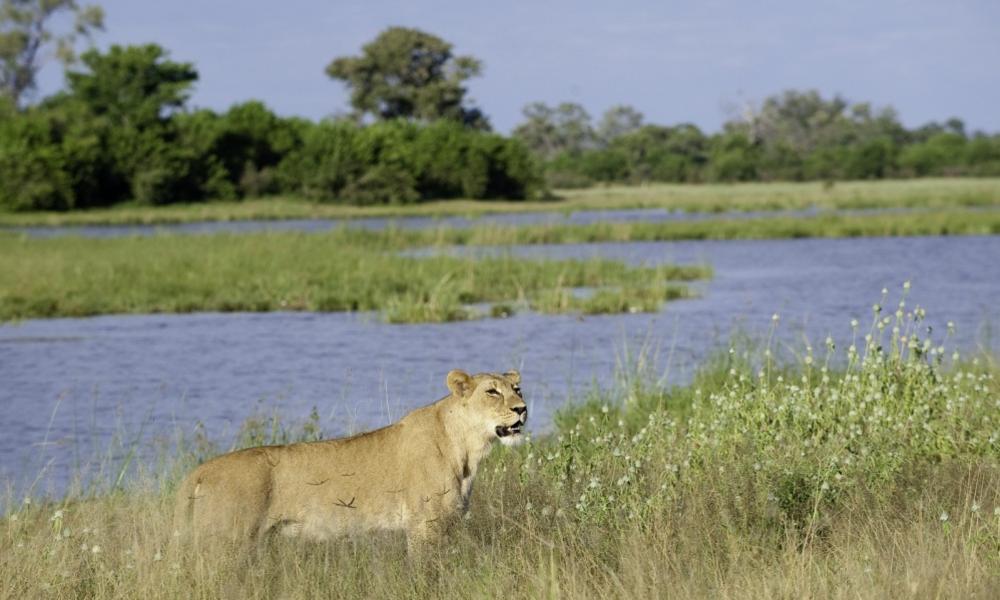
Lioness_savuti_channel_dana_allen_wilderness_safaris© Dana Allen/Wilderness Safaris
A lioness patrols the water's edge along the Savuti Channel in Botswana.
We flew northeast from Seba Camp in Botswana’s Okavango Delta to the Chobe airstrip. A rich network of wildlife trails clearly visible from the air told us that, despite the apparent barrenness of the landscape, animals were abundant beneath us.
After landing, we quickly drove westward toward the Savuti Channel, a linear oasis in a landscape otherwise lacking surface water at the end of the dry season. The only water available for many miles, Savuti is a magnet for herds of buffalo, zebra and impala and for solitary giraffes, kudu and warthogs. Egyptian geese and jacanas graced the shoreline, African fish eagles filled the air with their ringing cries, and an osprey, a long distant migrant from Europe, dove for its fish lunch.
Our reward? Finding a pack of wild dogs with six half-grown pups resting in what little shade they could find at the bases of the leafless trees. The adults were clearly successful in capturing enough prey—probably impala—to satisfy six hungry mouths and their own.
Guided by information he received over the radio from other guides, our capable expedition leader Thuto Moutloatse spotted a cheetah resting beneath a shrub. The bush had just enough leaves to cast a streak of shade from the hot afternoon sun.
Although we were protected from the sun by the canopy of our safari vehicle, we too welcomed natural shade. In our case, it was beneath spreading fig trees along the bank of a channel where grunting hippos peered at us while we ate sandwiches.
Thuto’s keen eyes soon spotted a pride of lions resting in the bushes on a low ridge overlooking the water. A group of nine females and young males, they were clearly assessing the options for their evening hunt.
“See that solitary buffalo?” Thuto pointed out. “The lions are going to kill it tonight.”
He may have been right, and we wished we could have stuck around to find out. But our destination for the night was still a long drive away.
“We must hurry,” Thuto reminded us, but then he couldn’t resist stopping to point out another pride of lions along the way. We also repeatedly halted to let elephants cross our path. They were heading for water—their version of happy hour, perhaps?—but were indifferent to our need to reach camp before dark.
The last traces of pink remained in the western sky when we finally approached arrived at camp. We were tired and hot—and, yes, thirsty too—but none of us would have preferred to arrive earlier.
Ecologist and author Gordon Orians is a emeritus member of WWF's Board of Directors and professor emeritus of biology at the University of Washington in Seattle.

How You Can Help

Connect with WWF

Monday, January 7, 2013

Missouri

GPA 0.94
State rank: 34th
Overall
Grade
Currently, Missouri's education policies do not prioritize great teaching, empowering parents with quality choices, or allocating resources wisely to raise student achievement. The state is behind when it comes to enacting critical education reforms. Missouri has moved to improve its educator evaluations, but the new system is not meaningful, and districts are not required to link student performance, educator performance, and personnel decisions. The state should free teachers locked into the state's existing pension systems by offering more attractive, portable retirement options. Missouri could empower parents more by providing meaningful information regarding school and teacher performance. The state recently strengthened accountability for public charter schools and expanded authorization, both positive steps forward. State policy should prioritize the establishment and replication of high-performing schools as well. Finally, Missouri should allow mayors to take control in low-performing districts and strengthen the state's ability to intervene in low-performing schools.

Where Missouri Ranks

GPA
2.880.940.4LAMOND

Missouri Fast Facts

Stats, 2010–11

STUDENTS 918,710
SCHOOL DISTRICTS 567
SCHOOLS 2,410
PUBLIC CHARTERS 53

NAEP Scale Score Rank, 2011

4TH
GRADE
MATH READING
27 31
8TH
GRADE
MATH READING
32 24

NAEP Proficiency, 2011

58%
42%
66%
34%
4TH GRADE
MATH
READING
Fast Facts Source: U.S. Department of Education, National Center for Education Statistics, Common Core of Data (CCD), and National Assessment of Educational Progress (NAEP), 2011 Mathematics and Reading Assessments.

Elevate
Teaching

State rank: 39th
GPA 0.73
Missouri is behind when it comes to ensuring effective teachers and principals are identified, retained, and rewarded by districts. Missouri does not require districts to evaluate educators in a meaningful way. Although student academic growth plays an undefined role in evaluations, evaluations lack annual frequency and there are no consequences for poor performance. Seniority drives personnel decisions, allowing other states to pass Missouri by in efforts to improve teacher quality and elevate the profession. If Missouri wants to strengthen its teaching corps, it must treat them like the professionals they are by establishing meaningful annual evaluations tied significantly to student growth and requiring districts to use teacher effectiveness as the driving factor in recruitment, placement, layoff, tenure, and compensation decisions. The state should also improve the selectivity and quality of its alternative certification pathways.

Empower
Parents

State rank: 9th
GPA 1.24
All families should have the information and access they need to provide a quality education for their children, and no student should be forced to attend a low-performing school or be taught by a low-performing teacher. Therefore, Missouri must empower parents to take action by providing meaningful information on school performance and more high-quality school choice options. Missouri must require PK-12 schools to receive an annual report card that includes an A-F letter grade based on student achievement data. Also, the state should require parental consent if a student is placed with an ineffective teacher and grant parents the power to petition local school districts to turn around failing schools. The state must do more to increase high-quality school choice options by removing restrictions on charter school growth, strengthening charter accountability policies, and creating a publicly funded scholarship program for low-income students in chronically failing public schools to attend private schools.

Spend
Wisely

State rank: 45th
GPA 0.89
Missouri is not permitting its districts to use resources wisely and has yet to develop strong accountability measures. The state may undertake limited intervention in schools that lose accreditation, but Missouri should establish stronger models that enable robust state authority and targeted mayoral control for other low-performing schools and districts. To enhance transparency and accountability and promote data-driven decisionmaking, Missouri should require districts to link spending to academic achievement and allow governance changes when resources are mismanaged. To provide all teachers with career flexibility and retirement security, Missouri should move to fully portable retirement plans.

Friday, January 4, 2013


Dear Jenni,

Fur-Free Friday was a raging success this year, with more than 60 protests in the U.S. and Canada to protest the use of fur as well as leather, wool, down, and exotic skins! Check out these articles from San Francisco; Seattle; Portland, Ore.; Philadelphia; Chicago; Concord, N.H.; and Long Island, N.Y. as well as these two from Beachwood, Ohio.

Here are some photos from protests across the U.S. to inspire you to speak up for animals all winter long and beyond:


I'd love to help you get active for animals by sending you free leaflets about animals killed to make fur garments and other clothing items. You can pass the leaflets out and make a difference for animals just as the people in the photos did! Please let me know how I can help you. I look forward to hearing from you!

Sincerely,


Lauren Stroyeck
Action Team Coordinator
LaurenS@peta.org
757-962-8205
People for the Ethical Treatment of Animals

Make a Resolution for Happy and Healthy Pets in 2013

Wednesday, January 2, 2013 - 3:00pm
 161  39  6  5
Black and white puppy
Happy new year from all of us here at the ASPCA! As you set your resolutions for 2013, don’t forget to consider ways to improve your pet’s wellbeing, too. Providing a little bit of extra grooming or playtime for your pet can go a long way. We suggest you start by making a few simple resolutions that will keep your furry friends healthy and happy from January to December.
Here are some easy ways to get started:
Exercise time! Before you rush to join a gym, consider ways to incorporate your pet into your new workout routine. Healthy adult dogs need at least 30 minutes of aerobic exercise twice a day—jogging, swimming and playing at the dog park are all great options. Engage your cat with rousing play sessions of chase and fetch with furry toys, small balls or toy mice.
Battle the bulge. Humans aren’t the only ones who might need to cut back on excess food after the holidays. This year, vow to lay off those table scraps and consider switching your cat or dog to a well-balanced, high-quality pet food.
Schedule a check-up. Give your veterinarian the chance to notice any developing illnesses by scheduling regular check-ups for your pet. If it’s been a year or more since your pet has seen a vet, make an appointment today!
IDs, please! Get an updated look by outfitting all of your animal companions—even indoor pets—with an ID tag. Implanted microchips are also a smart option.
Want to make a resolution to help homeless animals in 2013? Consider becoming an ASPCA Guardian. For just a few cents a day, you can make a big impact for animals.  
The Harshman Law Firm wishes you . . .

2013 New Year Discounts !!


Your friends at The Harshman Law Firm would like to wish you a glorious, rewarding and peaceful new year. This time means a chance at a new beginning.

$200 off of a Ch. 7 Bankruptcy

$200 off upfront cost of a Ch. 13 Bankruptcy (deferred fees)

25% off all Traffic Tickets

Please feel free to use these discounts for yourself or forward to a friend or family member for future legal services.  As always, we offer a Free Initial Consultation.  We appreciate your continued business and support.  Start the new year right by getting your life in order.

Sincerely, Joani, Kate, Bailie, Sarah & Chad

The Harshman Law Firm
218 Delaware, Suite 307
Kansas City, MO 64105
816-842-4275
info@harshmanlaw.com
www.harshmanlaw.com
like us! www.facebook.com/harshmanlaw


Leaked Video: Live Goats' Legs Cut Off With Tree Trimmers

Each year, more than 10,000 live animals are shot, stabbed, mutilated, and killed in horrific military training exercises that are supposed to simulate injuries on the battlefield. But the training exercises that are taking place in these highly secret courses bear no resemblance to real battlefield conditions—and they don't help soldiers save the lives of their injured comrades.
In disturbing, never-before-seen undercover video footage leaked to PETA showing a Coast Guard training course in Virginia Beach, Virginia, instructors with a company called Tier 1 Group, which was hired by the military, are seen breaking and cutting off the limbs of live goats with tree trimmers, stabbing the animals, and pulling out their internal organs. Goats moan and kick during the mutilations—signs that they had not received adequate anesthesia.
During this cruel exercise, one Tier 1 Group instructor is heard cheerfully whistling on the video as he cuts off goats' legs and a Coast Guard participant callously jokes about writing songs about mutilating the animals.
Later in the day, according to the distraught whistleblower who came to PETA, goats were shot in the face with pistols and hacked apart with an ax while still alive.
Following official complaints from PETA about this disturbing video footage, which showed Tier 1 Group instructors failing to provide adequate anesthesia to goats who were stabbed and cut into, the U.S. Department of Agriculture cited and issued an official warning to Tier 1 Group for violating the federal Animal Welfare Act.
Additionally, the Virginia Beach Zoning Administration sent a letter of warning to the owner of the property where the training allegedly took place, notifying him that these exercises are not permitted there and that legal action may be pursued against him if such unauthorized activities are conducted on the land in the future.
Cruel exercises like these continue regularly across the U.S. even though most civilian facilities and many military facilities have already replaced animal laboratories with superior lifelike simulators that breathe, bleed, and even "die."
The Army's own Rascon School of Combat Medicine at Fort Campbell does not use animals in its training program and has even publicly stated that "[t]raining on [simulators] is more realistic to providing care for a person than training on animals." The Air Force's Center for Sustainment of Trauma and Readiness Skills and the Navy Trauma Training Center also do not use animals to train soldiers, and nearly 80 percent of NATO allies have informed PETA that they do not use animals for military medical training.

Department of Defense regulations actually require that alternatives to animals be used when available, but this policy is not being enforced.
Unlike mutilating and killing animals, training on simulators allows medics and soldiers to practice on accurate anatomical models and repeat vital procedures until all trainees are confident and proficient. Studies show that medical care providers who learn trauma treatment using simulators are better prepared to treat injured patients than those who are trained using animals. A leading surgeon with the U.S. Army even candidly admitted in an internal e-mail obtained by PETA that "there still is no evidence that [training on animals] saves lives."
For all these reasons, the Battlefield Excellence through Superior Training (BEST) Practices Act (H.R. 1417/S. 3418), which would phase out the U.S. military's use of live animals in trauma training in favor of modern non-animal methods, has been introduced in Congress.
Please help improve military training and spare the thousands of animals who are tormented each year in these cruel exercises by using the form below to send polite e-mails to U.S. Department of Defense and Department of Homeland Security officials urging them to take immediate action to comply with federal regulations and completely replace the use of animals in military trauma training with superior non-animal training methods.